17/07/2026 - Phnom Penh
You’ve heard of catfishing on IG, well some orchids have been doing it for millennia.
Some look and smell like a real snack, but when the bug arrives... zero nectar! Total scam!
For these orchids, it’s pay-back time: they are getting way less attention than they used to.
Bugs seem to finally be getting woke to the orchid's cat-fishing game and they are swiping left on the drama. If you’re a flower and your only move is "deception,” you may just end up alone in the jungle, periodt.

Paphiliopedilum villosum - Entertaining highly toxic relationships, the "Slipper Orchids," trap bugs in their 'pouch' and force them to crawl through a narrow tunnel just to get out covered in pollen — for nothing in return.

The Receipts
Botanists just performed a massive vibe-check on museum specimens from 1800 to today. We are talking 200 years of historical "meet-up receipts" (herbarium sheets) tracked by the Royal Botanic Gardens, Kew, to see how wild orchids and their pollinators are getting along. The data dropped a massive truth bomb: pollination rates are on a steady decline.
It’s a literal centuries-old ghosting epidemic. The matchmaking system is broken through habitat loss and climate change. No Cap. (Link to the full receipts: Torres-Montagner et al., 2025).

A Tylopelta gibbera on Bulbophyllum dissitiflorum

The Tea:
- The Massive Flops (Disa & Oncidium): Pollination rates for the African Disa and tropical American Oncidium dynasties have significantly plummeted over the last two centuries. The study found that "specialist" orchids (the picky daters that only vibe with one specific insect match) and "deceptive" orchids (the catfishes that offer zero food rewards) are catching the most grief and struggling the hardest to reproduce as their partners disappear.
- The Slay Orchid (Ophrys): On the absolute flip side, Europe's Ophrys genus is completely defying the odds and seeing a significant increase in pollination success. They’ve managed to keep their rizz because they specialize in sexual deception—releasing fake pheromones and physically mimicking female bees. Desperate male Apidae (honeybees), who are adapting better to human cities, keep swiping right and falling for the trap. Pure alpha energy.


Scammers and "picky" daters exposed
Due to habitat and climate changes the dates are often cancelled. Timing is the key. If the orchids bloom before or after their pollinators are active, no seeds = no next generation - low key nightmare.
Being ‘extra' during this crisis is a massive risk. With limited opportunities to find their match, picky daters are now highly exposed. Bugs are not buying into low-reward situation-ships anymore. Flowers that offer rewards stand more chances.

Such a Simp! The Dendrobium anosmum emits a sweet raspberry smell (raspberry ketone) that acts as precursors to the male Bactrocera flies' pheromones. The fly eagerly consume these compounds directly from the flower tissue. This boosts the fly's mating success by maximizing the potency of its sex pheromones to attract females.

The Gold-diggers are still lurking
With over 11,000 nectar-less orchids out there, there are still many successful gold-diggers. These absolute red flag orchids use common hacking tools that include ID theft (visual or chemical mimicry), brute force and even social engineering. Yes, you heard that right!
A champion in the kinky chemical rage-bait category is the nectar-less Dendrobium sinense, found only on the Chinese island of Hainan. It sends out the smell of scared honey bees to enrage their sworn enemies the hornets. With multiple plants flowering at the same time, the hornets have no chill. They just lose their mind in a rage-fuelled pollination frenzy. Exited by the fake alarm pheromones, they start to pounce on a small red dot on the masochistic flowers, unknowingly collecting and spreading pollen.

A red dwarf honey bee (Apis florea) checking out the drip of a Cymbidium finlaysonianum

So it is confirmed: something hits different. Between habitat loss and climate change, the "meet-cute" between bugs and flowers isn't happening like it used to. But how hard does this 200-year-old ghosting epidemic hit Cambodian orchids? 💔
Cambodian Orchids Enter the Chat 🇰🇭
More research is needed to document the ghosting trend in the country but one thing we do know is that the local honeybees are already facing mounting challenges. Kew’s report makes it also clear: tropical zones are catching the worst of it. Between erratic seasons, habitat loss, and illegal poaching, Cambodia’s flora is under major stress as well.
But don't write off wild Cambodian orchids just yet. They didn’t get the memo that they were supposed to lie down and fade away. Instead, in their own and often punishing environments, they’ve developed pretty wild hacks and mastered "situation-ships" to make sure they get theirs.

A hover fly (Eristalinus megacephalus) exploring a bussin Rynchostylis gigantea

Some orchids simply refuse to be ignored and use aggressive ‘group-chat’ traps to force pollinators to interact. Take the Dendrobium crumenatum (Pigeon Orchid). It uses climate synchronization. The second a heavy rain drops the temperature, a countdown starts: 5 to 9 days later, boom. Every single Pigeon Orchid blooms simultaneously. Even though the flowers last only one single day, this massive flash-mob completely overwhelms the local insect population with options.
It's giving "You will see us on your feed" vibe.

The Dendrobium crumenatum (Pigeon Orchid) reacts to temperature changes to trigger flowering.

Even more spectacular, the Papilionanthe pedunculata. Living in the chill, temperate vibes of Bokor, this orchid sets up a high-reward, high-drama trap for big, powerful insects. It drops a summer "floral feast" of striking bright pink and white flowers that bees literally cannot ignore. It’s a mass-flowering flash-mob strategy. But there’s a catch: the nectar reward is hidden deep at the bottom of a spur, forcing a "bouncers-only" entry. A large bee has to shove its entire head and thorax deep into the center , perfectly positioning its back to get smacked by sticky pollen packets (pollinia). Because the meal is actually legit, the bee gets trained to hunt down the next one. High effort, high reward.

The spectacular Papilionanthe pedunculata flexing its petals

Some Cambodian orchids have their kinks too. The Bulbophyllum macranthum is no stranger to challenging gender roles. This one uses sensual persuasion mixed with literal brute force. First, it releases a special perfume called Zingerone—a chemical reward that doubles as an irresistible attractant for male fruit-flies. Once the naive fly lands, the orchid takes total control. Using a spring-loaded lip mechanism, the flower literally flips the fly, bashing it against the pollen. The plot twist? While getting absolutely beat up, the chemical reward boosts the fly's hormones and upgrades its sexual prowess. A certified Stan is born.

Bulbophyllum macranthum getting a glow up

“Fine, I’ll Do It Myself" 💅👑
When the ghosting gets to be too much and the pollinators stop swiping right, some orchids decide they don't need a partner to build an empire. Enter Cleistogamy—the ultimate evolutionary insurance policy of self-pollination.
Arundina graminifolia (Bamboo Orchid): One of the thriving icons in Cambodia, commonly spotted slaying along sunny forest edges and roadsides. It has large, gorgeous flower meant to attract bees, but it’s secretly a master colonizer. In many populations, it completely deletes the rostellum (the physical barrier between its own male and female parts). The pollen just drops straight into the stigma. No dates needed. That’s why nearly every single Bamboo Orchid you see is packed with seed pods. Zero drama, pure privacy mode.

The Arundina graminifolia giving its usual main character energy...

This goes to sh0w that many Cambodia’s orchids already have their own evolutionary hacks to try to survive the spell. Whether they are overwhelming the timeline with mass blooms , baiting bugs with kinky chemical rewards , or just affirming their self-pollination era, these plants are fighting for their lives.
Unfortunately their "insurance policies" can only go so far. Self-pollination for example keeps the species alive, but it lacks the genetic remixing that cross-pollination brings to keep them resilient on the long-term.
If we keep letting habitat loss, pesticide misuse, and climate change ruin the vibe , even the cleverest queens will eventually run out of luck. It’s time to protect our biodiversity corridors, and make the jungle a safe space for pollination meet-cutes again.
More coming on this amazing plant, meanwhile, touch grass!
#OrchidClickBait #PollinatorRage #SaveTheForestRizz #GreenVibesKH
To find out more about this term, there was one key person to ask: Cambodia’s Orchid Ambassador Dr. Hul Sovanmoly, esteemed Academic and Researcher (botanist / taxonomist) in Tropical Botany, specialised in the Asian Flora of the Indochinese Peninsula, particularly of Cambodia, Laos and Vietnam – and long time expert of the French National Museum of Natural History, Paris.
We asked her for more information on the origins of the word ‘កេសរកូល’ (kesorkol). Please click on the read more button below for the full story in english or click on this link to read the article in French language

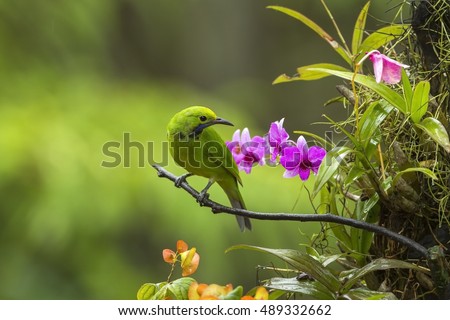
The photo was taken by Vuthy Phan, in Mondulkiri, Cambodia, 2016.
The orchid is the distinctive Dendrobium secundum – also known as the ‘tooth-brush’ orchid.
A bird expert, Rob Overtoom, helped to identify the bird as a male Chloropsis aurifrons or more commonly known as the ‘golden-fronted leafbird’.
The documentation of orchid pollination by birds is rare and was previously documented in the region by Burkill in 1919 in Singapore (Cf.).This photographic evidence is an important sign that orchid pollination by birds is most likely taking place in Cambodia. There is a need for more documentation and substance to make a more definitive claim and perhaps this intrigue will inspire scholars and researchers.
For starters, Darwin reminds us with a short and simple phrase about evolution, that ‘what is considered useful is kept’. And so over millions of years, the relationship between species evolved. Some flowers seemed to have 'found it useful' to even mimic some insects. Orchids are famous for this. But they are not the only ones to have developed strategies. For example, you may be interested to watch this Mantis Orchid relationship.… This demonstrates rapidly that, while orchids have their own ‘strategies’, they are not alone. Each species is left to its own and has to devise both survival strategies and reproductive ‘plans’. These strategies and plans are unfolding all the time between all species, overlapping, complementing or conflicting with each other.
Therefore to make sense of the photo above, we need to take both the bird and the orchid perspectives and try to understand how these come together in this picture. For this, here is an enlightening excerpt from Van der Pijl and Dodson:
“What else makes an orchid good for birds?
1. Vivid colors
2. Absence of odor because birds lack the sense of smell
3. Small or curved-back flower lip since birds do not need to land on flowers
4. Abundant nectar in medium-length, rather broad tubes with a capillary system
5. Tubular horizontal flowers, often hanging free, with space for hovering birds
6. Hard flower walls with protected organs because of hard bird beaks
7. No nectar guides since they are not necessary for birds”
With this in mind, we can already refine our search and rule out some possibilities:
1. The Perspective of the golden-fronted leafbird:
-Is it a mating strategy ? Is the bird waiting to meet a companion like this female standing near other Dendrobium species? While this (and shyness) cannot be ruled out, on the photo at least, the male seems to show more interest in the flowers.
-Is the bird looking for food and if so… what kind of food?
This bird is known to go on orchid bananas binges and also eats fruits like berries, but it is unlikely to have mistaken orchid bananas for orchid flowers. Still flowers are a pretty easy spot to find insects, specially for this one. It is therefore possible that the bird is hunting for insects inside the flowers - and acts as pollinator by visiting other flowers.
-Is the bird collecting nectar?
The spiked tongues of the golden-fronted leafbird are well adapted for taking nectar from tubular flowers.
Like hummingbirds, they can hover in front of a flower while retrieving the nectar. Descriptions of the D. secundum resonate well with this bird’s view point: 'waxy glossy, fragrant tubular flowers that do not open well…on cane-like semi-pendulous and leafless stems’...perfect to land on. There is a strong lead here….
2. The Perspective of the Dendrobium secundum:
Orchids use flowers to reproduce. They need pollinators to carry their pollen between flowers. They have developed multiple ways to attract pollinators (flower shapes, colors, fragrances, pheromones…).
The D. secundum is a fragrant orchid – many orchids use the stratagem of smell and produce pheromones that mimic the smell of food or of the ‘opposite sex’ – but since birds have no sense of smell this strategy applies to insects and there is another problem…the D. secundum is not known to produce nectar. So the plot thickens...
Is the bird’s visit simply coincidental?
Can answers be found looking at the flowers? The D. secundum is known as the ‘Toothbrush orchid’ because of its perfectly lined and upward standing flowers. This is a distinctive feature. Its stems are also leafless when in flower, making it easy for birds to land and access the flowers.
While the shape of the flowers makes it unlikely for rain to penetrate, it is possible that the tubular shape is able to capture and keep mist water / dew and the bird could be attracted to drops of water kept in the flowers. Additional research could help answer some of these questions.

Most interestingly, the Chloropsis aurifrons is particularly attracted to flowers that look nearly the same shape and size as Dendrobium secundum, with a similar shaped inflorescence, particularly the flowers from trees, such as Erythrina fascia, that is common in Cambodia. The ressemblance with the D. secundum is striking both in shape but also in vibrance with species such as the Erythrina orientalis. The flowers of D. secundum are a unique vibrant-pink color and this differs from the reddish colors of the flowers of the Erythrina.
But humans and birds see things quite differently. All birds are known to have near-UV vision, and this feature is expected to be important in their foraging behavior. Some orchid species have bright near UV reflectance and this may help birds recognise their flowers - Van der Pill and Dodson give more details: 'interestingly a feature is that most bird pollinated orchids do not have highly contrasted UV. Yet many orchids that are pollinated by birds ie Dend. do have such features.’ and… ‘Dendrobium species possess a dramatic bullseye pattern in the near UV (370-390 nm).’

- Key Findings: There is an eerie resemblance between the flowers and stems/branches of D. secundum and Erythrina fascia. These features are attractive to the Chloropsis aurifrons that has now been witnessed visiting both species. While fragrant (relevant for insects), the D. secundum does not produce nectar.
- Questions that remain to be answered: Does the bird collect a reward: insects (attracted by the fragrance), or is there for nectar/water? If not, is the bird deceived, mistakenly thinking he is visiting a nectar producing flower? If so is the UV color spectrum relevant to the orchids’ strategy?